Forty minutes underground move through tens of millions of years of geological time.
The Journey Begins Not with a Road, but with Time
Most journeys begin with a road.
This one begins with the feeling that ordinary time has stopped working.
Outside, the trees rustle in the wind, the sun shines overhead, and visitors pose for photographs at the entrance.
A few steps inside, everything changes.
The air becomes cool.
The sounds grow quieter.
Above your head stretches a world that began forming around 80 million years ago.
When dinosaurs still walked the Earth, this story had already begun.
The strange thing is that you cannot actually see it happening.
Not because it ended long ago, but because it is still unfolding—far too slowly for us to notice.
The First Steps Underground
A guided tour through Resava Cave lasts less than an hour.
During that time, you walk about 800 metres along well-maintained pathways, gradually descending deeper into the limestone mountain.
The temperature remains close to 7°C (45°F) throughout the year, so even in the middle of a Serbian summer you’ll be glad to zip up a jacket.
Water drips somewhere in the darkness.
Footsteps unexpectedly echo through the chambers.
Your eyes slowly adjust to the soft lighting.
The cave feels completely still.
But that impression is deceptive.
A Palace Nobody Designed
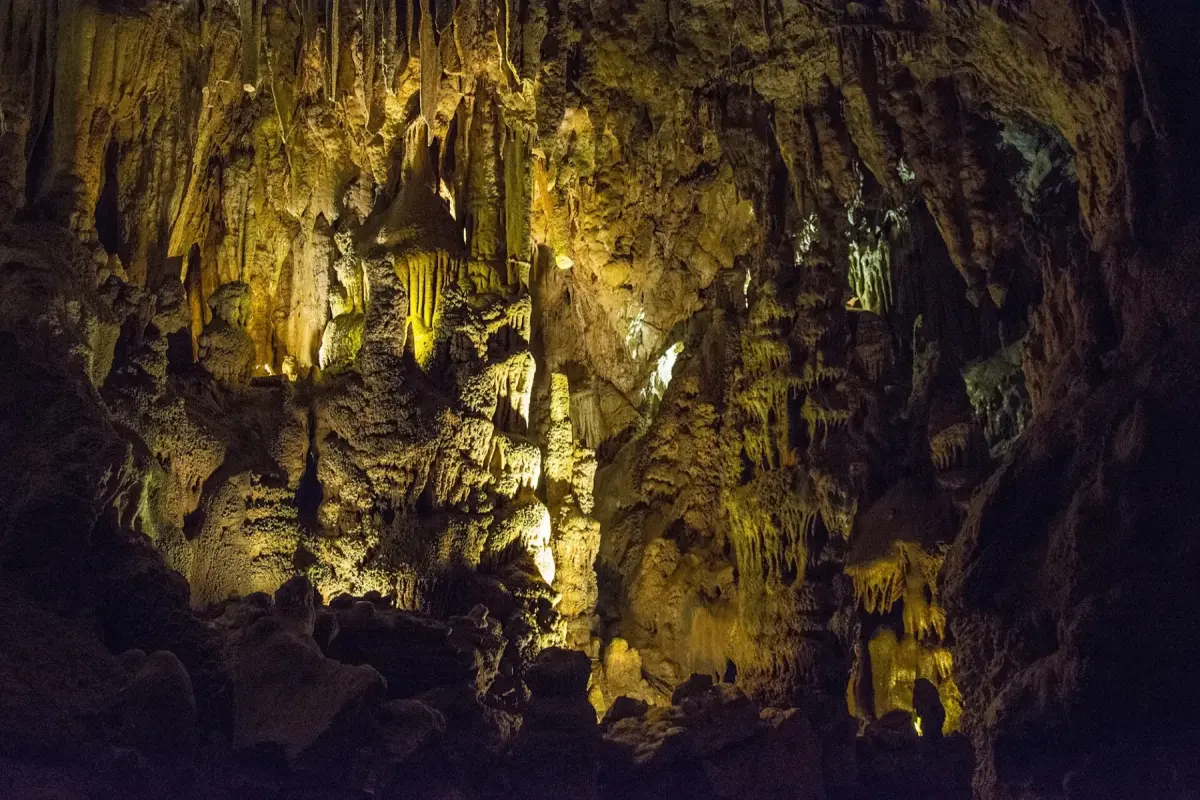
Looking at the towering columns, vaulted ceilings, and flowing folds of stone, it is difficult to believe that no architect ever planned any of it.
No one decided where the next pillar should stand.
No one drew the blueprint for the next chamber.
Water simply found another crack in the limestone.
It dissolved the rock.
Then it left behind the thinnest possible layer of minerals.
Then another.
And another.
After thousands of years, chance became shape.
After tens of thousands more, those shapes became part of an enormous underground palace.
People arrived much later.
They simply gave names to what they saw.
Some formations reminded them of columns.
Others looked like stone curtains.
Still others resembled the pipes of a giant organ.
“Still others resembled the pipes of a giant organ.”
Perhaps that is why imagination comes so naturally here.
Nature was never trying to imitate anything.
Yet almost everyone discovers something different hidden inside the stone.
When Air Becomes the Sculptor
Most of us imagine caves in a very simple way.
Water drips from the ceiling.
A stalactite slowly grows from each drop.
Resava Cave reminds us that nature is rarely that straightforward.
Some of its unusual coral-like formations were shaped not only by water, but also by air currents.
Those currents carried microscopic droplets and mineral particles in different directions, allowing parts of the formations to grow in ways that seem to defy ordinary logic.
Even here, nature found another way to surprise us.
Time You Cannot See
The strangest feeling does not come from looking at the stalactites.
It comes from understanding the scale of time.
To us, stone feels eternal.
A geologist would probably disagree.
Stone is simply changing too slowly for us to witness.
Over the course of a human lifetime, many formations barely appear to change at all.
That does not mean they have stopped growing.
The cave is still quietly building itself.
A World That Only Seems Lifeless
There is another detail that is easy to miss.
The underground world is not empty.
Creatures have adapted to the permanent darkness, constant humidity, and cool temperatures.
Most visitors will never see them.
Simply knowing they are there changes the way the cave feels.
It stops being beautiful scenery.
It becomes a separate world with its own life and its own rules.
What to Know Before You Visit
Resava Cave cannot be explored independently.
Entry is only possible as part of a guided tour.
The route itself lasts around 40–45 minutes and follows well-maintained paths and stairways, so it is worth checking the latest tour schedule before arriving and choosing a convenient departure time.
If you are travelling by car, consider planning an entire day around the trip.
The nearby Manasija Monastery and Veliki Buk Waterfall complement the visit perfectly.
Even if summer temperatures outside are high, the cave remains close to 7°C (45°F) all year.
Bring a light jacket or sweatshirt and wear comfortable shoes with good grip, as some steps and walkways can be damp.
Do not expect a full-scale caving expedition.
Resava Cave is a well-equipped tourist route suitable for almost everyone.
And try not to rush.
When your group moves into the next chamber, pause for a few extra seconds if you are not holding anyone up.
Listen to the sound of falling water.
Look around.
Imagine this stone world slowly changing long before the first humans ever appeared.
Sometimes those quiet pauses become the strongest memory of the entire journey.
What Else to See Nearby
If you still have time after the tour, do not hurry back.
Veliki Buk Waterfall is only a short drive away.
Interestingly, it was created by exactly the same force.
Water.
Only here, it works in a completely different way.
Underground, water spent millions of years quietly transforming cracks into vast chambers.
Outside, it crashes openly over the rocks, revealing the very same power in a completely different form.
- Add Manasija Monastery to the route, and your day suddenly spans three different scales of time:
- millions of years of Earth’s history,
- centuries of human history,
and one single day of your own journey.
Forty Minutes—and Millions of Years
Resava Cave may not satisfy visitors dreaming of a true speleological expedition.
The pathways are paved.
The cave is illuminated.
The experience follows a guided route.
But if you would like—even briefly—to feel how immense the history of our planet is compared with a human lifetime, it is difficult to imagine a better place.
When you step back into daylight, your watch will tell you that less than an hour has passed.
Yet somehow, those forty minutes managed to contain tens of millions of years.