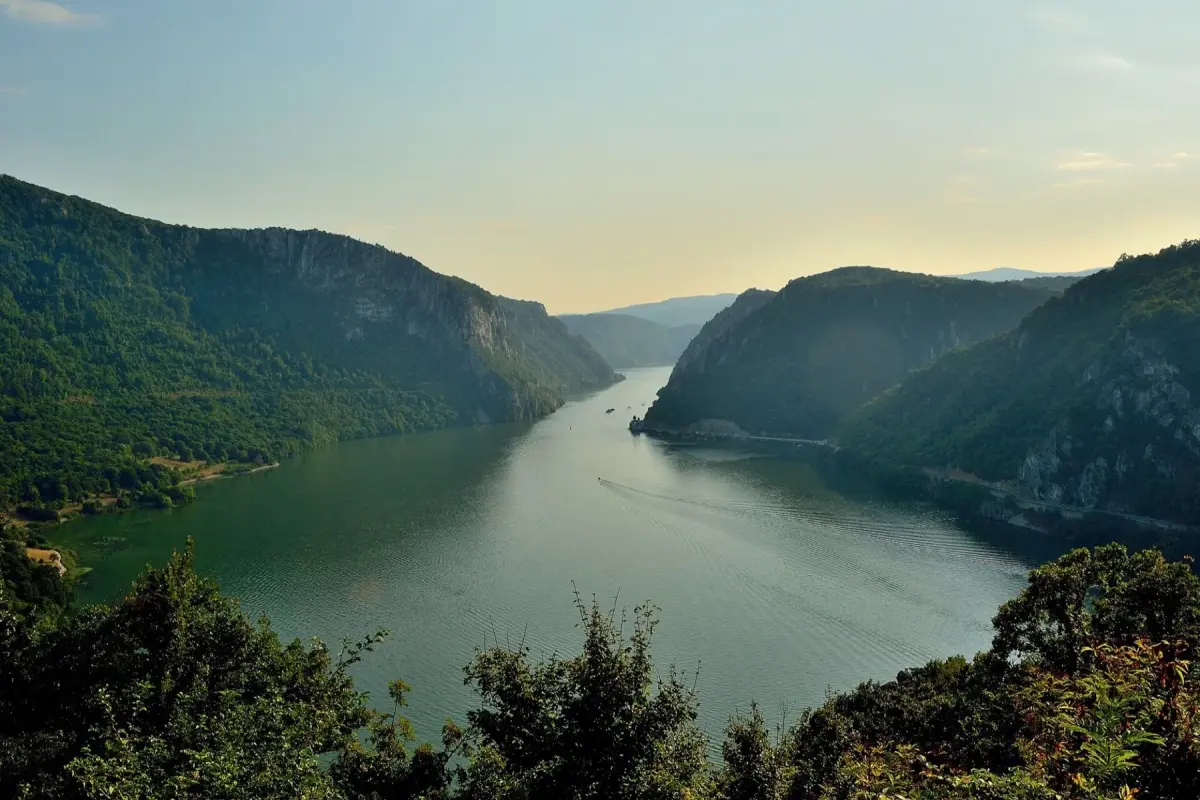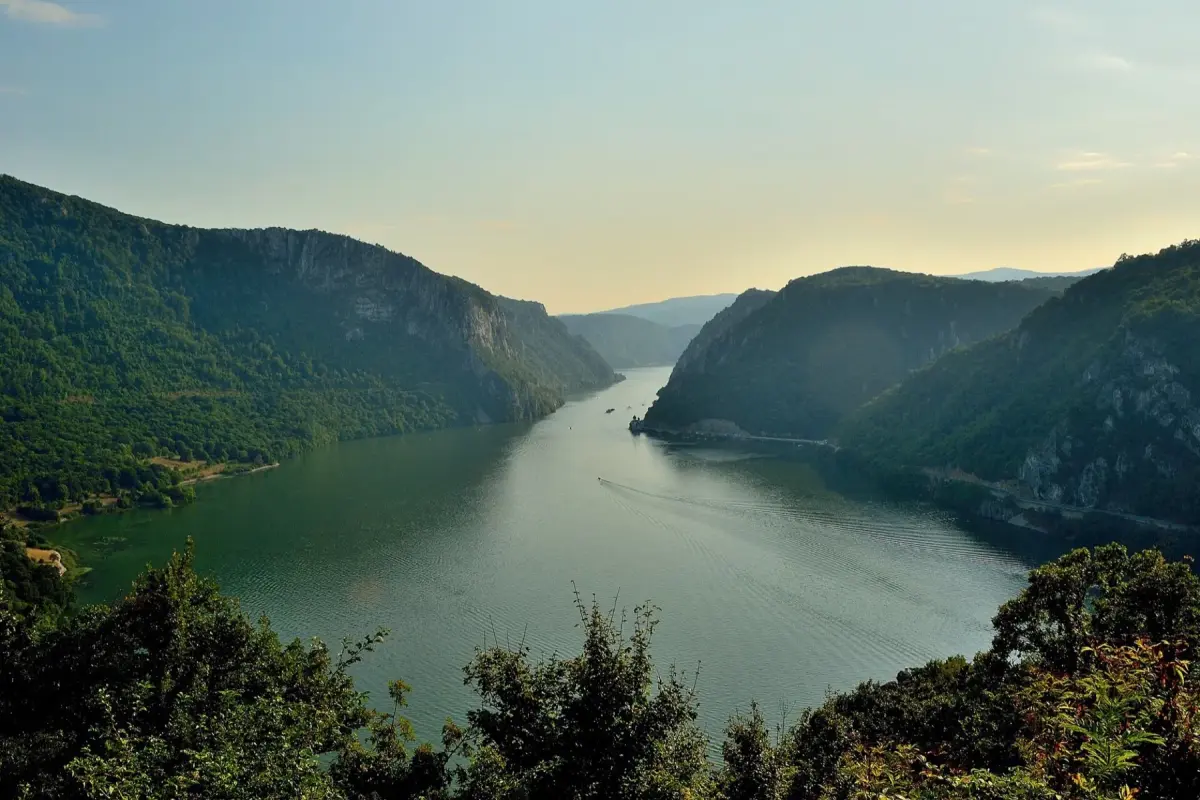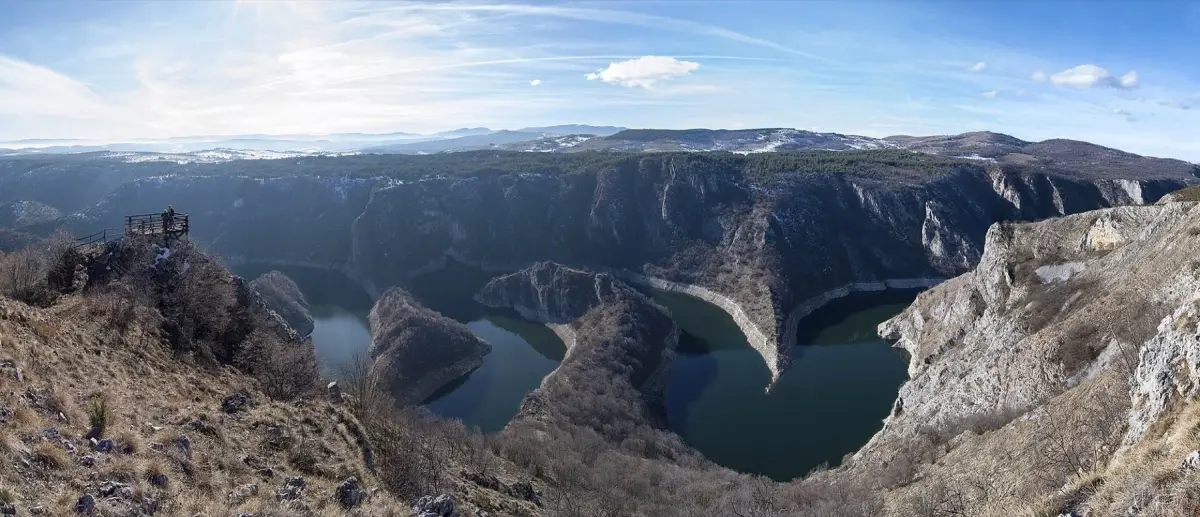
Bends so perfectly shaped that the Uvac looks less like a river than a hand-drawn line on a map.
Some landscapes are instantly recognisable, yet surprisingly difficult to understand.
The Uvac is one of them.
In photographs, it looks like a broad green ribbon folded neatly between rolling hills.
Its bends are so perfectly shaped that you begin to wonder whether someone imagined this place first, and only later did it appear on the map of Serbia.
But a photograph shows only the river’s handwriting.
To read the whole story, you need to look down on the Uvac from above, descend to the water, and, at least once, lift your eyes away from the canyon to watch a shadow drifting slowly across the cliffs.
A River That Refused to Go Straight
The Uvac does more than simply curve.
Some of its bends almost close in on themselves, forcing the river to wrap around a limestone ridge before flowing back towards the direction it had just left.
These are known as incised meanders—a winding river that gradually carved its ancient course deeper into limestone over millions of years.
The result is a canyon whose cliffs rise several hundred metres above the water.
The valley is typically 200–300 metres deep, reaching around 350 metres in places.
From the viewpoints, those distances almost disappear.
The river seems close enough to touch, while the slopes flatten into an elegant green pattern.
Only when you stand at the edge do you realise how deeply the water has carved into the landscape.
Today, the famous meanders are reflected in Uvac Lake, also known as Sjenica Lake.
The reservoir was created after the construction of a dam and is one of three artificial lakes along the Uvac Valley.
People changed the level and character of the water, but the ancient shape of the canyon remained—like an old drawing preserved beneath a sheet of dark glass.
Height Can Be Deceiving
The best-known view is from the Molitva viewpoint—its name means “Prayer.”
From here, several loops of the river unfold before you at once.
This is the image that fills postcards, guidebooks, and countless promises of seeing “one of Serbia’s most beautiful landscapes.”
Yet reaching it is not simply a matter of pulling over beside the road.
Depending on where you begin, you’ll need to walk several kilometres over uneven ground.
After rain, both the access tracks and the hiking trails become more demanding, making sturdy footwear far more useful than clothes chosen for photographs.
On the opposite side of the canyon lies Veliki Vrh.
The climb is shorter but steeper in places, and the river reveals itself from a completely different angle.
From Molitva, the Uvac resembles a line of calligraphy.
From Veliki Vrh, you feel the immense depth separating each curve.
Even so, neither viewpoint tells the whole story.
From above, you understand the shape.
You lose the scale.
To recover that, you have to descend to the water.
The Drawing Disappears
Something unexpected happens once you’re in the boat.
The famous meanders almost stop existing.
You no longer see the complete line or know how many bends remain ahead.
There is only water, another curve, and a limestone wall hiding whatever comes next.
This is where the Uvac stops being an image and becomes a place.
“This is where the Uvac stops being an image and becomes a place.”
The cliffs rise far higher than they seemed from above.
In places, the canyon narrows dramatically.
The colour of the water changes constantly with the light—green where it reflects the forests, grey beneath passing clouds, and almost blue where the sky reaches it between the cliffs.
Boat tours vary considerably.
Some remain on the lake.
Others include a landing and hike to a viewpoint.
Some continue to the Ice Cave.
Before booking, it is worth checking not only the length of the tour but also exactly what it includes.
A photograph of the meanders in an advertisement does not necessarily mean your boat will take you to the viewpoint where that image was captured.
A Door Inside the Mountain
Hidden within the limestone cliffs are dozens of karst caves.
The largest is the Ušačka Cave System, with more than six kilometres of explored passages.
It includes both Ušačka Cave and the Ice Cave, connected by the enormous Bezdan pit.
For most visitors, the Ice Cave is the highlight.
Its entrance opens directly from the canyon itself, meaning your journey underground begins from the water.
Only moments earlier, your boat was gliding between green slopes.
Then a dark opening appears ahead, and suddenly the river seems to invite you to continue the journey inside the mountain.
Inside, you’ll find stalactites, stalagmites, stone columns, and delicate mineral formations shaped by dripping water over thousands of years.
Only part of the cave system is open to visitors, and access depends on the season, water levels, and your tour operator’s itinerary.
Even in the middle of summer, it is worth bringing a warm layer.
Underground, summer ends almost immediately beyond the entrance.
A Shadow Above the Water
Sometimes a bird appears above the canyon, looking at first like nothing more than a distant black dot.
The illusion disappears as it approaches the cliffs.
The Griffon Vulture can have a wingspan approaching three metres, yet it hardly seems to flap its wings at all.
Instead, it spreads them wide and rises effortlessly on warm air currents.
Despite its appearance, it is not an eagle but one of Europe’s largest vultures.
It survives by feeding on animal carcasses, performing an ecological role that often goes unnoticed until it disappears—removing carrion and helping prevent the spread of disease.
By the end of the twentieth century, the species had almost vanished from Serbia.
In the early 1990s, only around ten breeding pairs remained.
Poisoning, the decline of traditional livestock farming, and the loss of natural food sources had pushed the birds close to extinction.
Years of conservation gradually changed that story.
Protected nesting sites, supplementary feeding stations, bird ringing, and long-term monitoring allowed the population to recover.
Today, the Uvac is home to Serbia’s largest breeding colony of Griffon Vultures and one of the largest in the Balkans.
In 2026, conservationists surveyed twenty nests and fitted six young birds with satellite transmitters to follow their first flights and long-distance journeys.
That alone is one of the strongest reasons to visit.
You are not simply watching a rare bird.
You are watching a species that almost disappeared from these skies before people managed to bring it back.
Farther Than It Looks
On a map, the Uvac appears close enough for a comfortable day trip from Belgrade.
The reality feels different.
Depending on which side of the reserve you visit, the drive covers around 250–280 kilometres and usually takes four to five hours before you even reach a trail or boat departure point.
Driving there and back in one day is possible.
It also means spending much of the day watching the clock.
A boat trip, the cave, and the hike to a viewpoint can easily fill most of the afternoon before the long drive home even begins.
Spending at least one night nearby makes for a far better experience.
If you’re approaching from the Sjenica side and planning to visit the Molitva viewpoint, staying in Sjenica or near Sjenica Lake is the most convenient choice.
Travellers combining the Uvac with Zlatar Mountain may prefer Nova Varoš, which offers more developed tourist facilities.
A Few Checks Before You Go
The best time for a first visit is generally from late spring to early autumn.
Summer offers the most reliable boat schedules but also the largest crowds.
Spring brings intensely green hillsides, although rain can make trails and access roads more challenging.
Early autumn is often quieter, with clearer air, but boat departures should be confirmed in advance.
Before setting out, choose more than simply “Uvac.”
Decide which side of the reserve you plan to visit, which boat dock you’ll use, and which viewpoint you want to reach.
Confirm the boat departure point, the duration of the tour, whether it includes the cave, whether you’ll hike to a viewpoint, and whether card payments are accepted.
Downloading offline maps is also a good idea, as mobile reception in the mountains is not always reliable.
Bring water, sun protection, shoes with good grip, a windproof jacket, and a warm layer for the cave.
A pair of binoculars will let you spot the vultures long before they transform from tiny dots into enormous birds.
When the Line Becomes a Place
It is surprisingly easy to remember the Uvac the wrong way.
You can leave with a single beautiful photograph of a river folding between green hills and think you’ve seen everything important.
The real impression comes from the contrast between three different perspectives.
From above, the Uvac looks like a drawing.
From the water, the drawing disappears and becomes a canyon.
Underground, another hidden world opens beneath the cliffs.
Above them, a bird that almost vanished from these skies glides silently overhead.
Only then does the drawn river stop being a line in a photograph.
It becomes something with depth, silence, the cool air of a cave, and the broad shadow of a vulture drifting slowly across the water.