A wooden village built for a film that never stopped being lived in.
Some places stay with us because they have preserved the past: an old castle, an ancient fortress, a street people have walked for centuries.
Mokra Gora works differently.
Here, the past was not preserved. It was imagined again.
And the strangest thing is that it proved so convincing that today it feels like part of the real history of the place.
On one mountainside stands a village that did not exist thirty years ago. Beneath it runs a railway that, by contrast, was never supposed to survive.
One was created for a film. The other was brought back to life decades after it had closed.
Together, they formed a place where reality and fiction no longer argue with each other.
That is why Mokra Gora is far more than another stop in western Serbia.
First, it helps to untangle the names, because almost every visitor confuses them at least once.
Mokra Gora is a real village and the surrounding mountain region between Tara National Park and the resort town of Zlatibor. The railway station is located here, the famous Šargan Eight departs from here, and high above the valley, on the top of a hill, stands Drvengrad.
Drvengrad, Mećavnik, and Küstendorf are three names for the same place: a wooden town built by film director Emir Kusturica.
So arriving “in Mokra Gora” does not necessarily mean you have seen everything. The railway lies below, Drvengrad sits above it, and the valley itself continues its ordinary rural life between the two.
It is precisely this combination that creates the feeling of entering several different worlds at once.
The Village That Never Existed
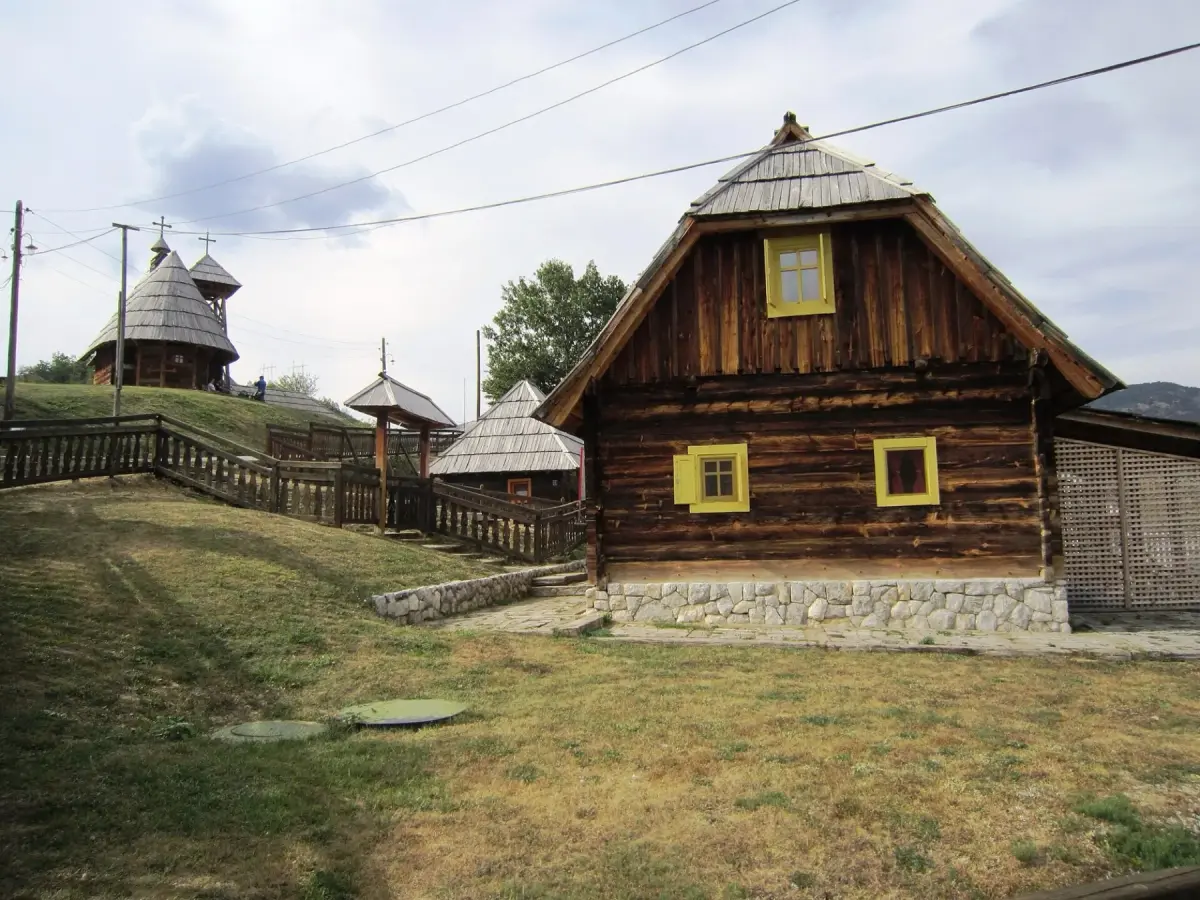
The first time you see Drvengrad, it looks like a carefully preserved nineteenth-century Serbian village.
There are wooden houses, cobbled streets, a small church, squares, carved balconies, and chimneys sending smoke into the winter air.
But that impression is misleading.
Drvengrad appeared only in the early twenty-first century, during the filming of Emir Kusturica’s Life Is a Miracle.
The story could have ended there.
Film sets are usually dismantled when production is over. Sometimes they remain standing for a few months, gradually deteriorating, before disappearing completely.
Here, the opposite happened.
Once filming was finished, Kusturica decided to let the village continue living a life of its own.
But there is another, even more interesting detail.
He did not simply build a collection of attractive wooden houses from scratch. Some of the log houses were brought from neighbouring villages. A few were nearly a century old. They were dismantled, transported, and rebuilt at the top of the hill.
That is why Drvengrad is neither an authentic historic village nor an ordinary film set.
It is an artistic project, a reconstruction, and a personal statement all at once.
As you walk through its streets, another distinctive feature begins to reveal itself.
They are named after people Kusturica considers important. Ivo Andrić, Nikola Tesla, and other writers, directors, and scientists appear on the map of the town.
This is not an attempt to recreate a real Serbian village. It is Kusturica’s own cultural world made physical.
Inside Drvengrad, you will find a hotel, restaurant, café, the small Church of Saint Sava, a cinema, gallery, library, souvenir shops, and several viewpoints.
The town itself is very small.
A quick walk through the streets takes only twenty or thirty minutes. A slower visit, with coffee, time to examine the houses, sit in the square, and linger at the viewpoints, takes around an hour and a half.
This is where the main disagreement about Drvengrad begins.
Some visitors call it one of the most unusual places in the Balkans. They love the idea that a director did not merely make a film, but built a world that continued to exist after the final credits.
Others leave disappointed.
They expected an authentic old town and found a modern tourist complex. Some feel that photographs create a stronger impression than the brief walk itself.
Both reactions are understandable.
Come expecting a vast open-air museum, and Drvengrad may feel underwhelming.
See it instead as a work of art that can be entered, inhabited for a few hours, or even slept in overnight, and the experience becomes something entirely different.
The Railway That Refused to Disappear
Below the hill, a completely different story begins.
If Drvengrad exists because of cinema, the Šargan Eight exists because of engineering.
This narrow-gauge railway was once part of a much larger route connecting Belgrade, Sarajevo, and the Adriatic coast. Trains ran here for decades until the line closed in 1974.
Its fate appeared final.
Then, almost thirty years later, a short section of the railway was restored.
Today, trains run along it once again.
The most interesting feature is not the locomotive or even the carriages.
The real attraction is the railway line itself.
Over a relatively short distance, the train must climb almost three hundred metres. For a conventional railway, the gradient would be too steep.
The engineers found an elegant solution.
They made the track change direction repeatedly, passing through tunnels, across bridges, and around loops while gradually gaining height. Viewed from above, some sections form a shape resembling the number eight.
That is how the railway became known as the Šargan Eight.
During the journey, the train passes through twenty-two tunnels and several bridges.
At times, it seems the carriages have only just emerged from the darkness before they vanish into another section of rock.
A few minutes later, the train suddenly appears almost directly above the place it passed not long before.
The journey is interesting for more than its scenery.
It offers a rare chance to see almost century-old engineering logic still working beneath your feet.
Not a Perfect Postcard, but a Real Journey
Promotional photographs can make the route look like an uninterrupted sequence of mountain panoramas.
The reality is different.
That is precisely why many visitors end up enjoying the journey more than they expected.
The view outside the window is not a continuous film.
Part of the line passes through dense forest. Then the train disappears into a long tunnel. A valley suddenly opens. Then there is forest again. Stone. Darkness. Light.
The rhythm constantly changes.
Wooden carriages rattle over the rails. The air smells of timber and metal. At the stops, passengers step out onto viewing platforms, photograph the mountains, return to their seats, and the train slowly disappears into another tunnel.
It is this shifting sequence of sensations that stays in the memory.
“It is this shifting sequence of sensations that stays in the memory.”
Do not expect every metre of the route to produce a new postcard.
And do not come only for the steam engine.
Although the historic steam locomotive remains one of the symbols of the Šargan Eight, regular tourist services may be operated by other locomotives. It is better to think of the journey as a heritage train with wooden carriages, not as a guaranteed steam-powered ride.
Many travellers recommend not spending the entire journey beside the same window.
When safety rules and the particular train allow access to the open platform between carriages, this is where the character of the railway can be felt most clearly: the wind, the noise of the wheels, the smell of the forest, and the sudden change of light after every tunnel.
That is when it becomes clear why people do not come here for perfect photographs.
The main experience of the Šargan Eight is the railway itself.
It is a rare opportunity to travel along a line that ceased to be part of a major transport network long ago, yet continues to live because people are still willing to travel slowly.
When the train returns to the station and Kusturica’s wooden town appears again on the hill above, the central paradox of Mokra Gora becomes visible.
The real railway has become a tourist adventure.
The village that never existed has become a place where people genuinely walk through the streets, drink coffee, spend the night, and watch the sun rise over the mountains.
Cinema did not end here with the final scene.
It simply stayed.
How to Build a Day Around One Railway
Mokra Gora looks compact: the station below, Drvengrad on the hill, mountains all around.
This can make it seem that three or four hours will be enough.
Sometimes they are.
But only when the train leaves shortly after you arrive, your ticket is already arranged, you do not linger anywhere, and you explore Drvengrad fairly quickly.
In reality, the day almost always expands.
The Šargan Eight journey itself usually takes around two to two and a half hours. You also need to allow time before departure, a walk around the station, the journey up to Drvengrad, lunch, coffee, and the inevitable pauses at the viewpoints that brought you here in the first place.
Four hours is therefore the minimum for someone following a strict schedule.
Five or six hours is more realistic for a visit without constantly checking the time.
The best option is to give Mokra Gora almost the entire day.
The main rule is simple: plan the day around the railway timetable, not around Drvengrad.
The wooden town will still be on the hill an hour later or after lunch.
The train will not wait.
When the departure is in the morning, it makes sense to arrive at the station first, take the train, and then head up to Drvengrad after returning. You can have lunch there and walk through the streets without rushing.
When the train leaves in the middle of the day, reverse the order. Visit Drvengrad in the morning, descend to the station well in advance, and avoid planning anything after the journey that requires a long drive.
The railway area and Drvengrad are close to each other, but one lies in the valley and the other on a hill. On a map, they appear almost side by side, yet the ascent, parking, and walking still take time.
With luggage, small children, or limited mobility, do not rely entirely on stairs and walking.
Mokra Gora is around forty kilometres from Zlatibor. The drive usually takes about an hour each way, so the visit should be treated as a full day out rather than a brief stop before dinner.
A Ticket Best Not Left Until the Last Minute
The Šargan Eight operates on a seasonal timetable.
The number of departures can change, and published schedules online often contradict one another. One source may show two departures a day, another three, while old reviews may describe services that no longer exist.
There is little value in memorising fixed times or planning around a photograph of an old timetable.
Departure times, prices, and ticket arrangements should always be confirmed directly with the railway operator shortly before travelling.
In summer, on weekends, and during public holidays, it is wise to reserve tickets in advance.
This becomes especially important when your entire day depends on one particular departure.
Driving from Zlatibor, Tara, or Višegrad only to discover that the train is sold out is one of the most frustrating mistakes—and one of the easiest to avoid.
Even with a reserved ticket, arrive at the station at least thirty to forty-five minutes before departure. This gives you time to park, find the ticket office, collect your ticket, and board without stress.
Parking is usually available near the station.
There is also parking near Drvengrad, although spaces may be harder to find in the middle of the day and during the busiest season.
The calmest time to arrive is in the morning, before the main flow of tour groups.
Where to Stay After the Journey
Leaving immediately after the train feels slightly unfinished.
Mokra Gora does not end at the platform, even though most visitors see only the station, Drvengrad, and the road between them.
There is a restaurant near the station, and accommodation is available within the railway complex. This suits travellers who want to wake beside the tracks and reach an early departure without rushing.
Drvengrad also has a restaurant, café, and accommodation.
Spending the night inside the wooden town changes the experience. Once the daytime groups leave, the streets stop feeling like a tourist attraction and begin to resemble a small, enclosed settlement.
But this is not the only option.
Private guesthouses in Mokra Gora suit visitors who prefer ordinary village quiet and do not want to remain entirely inside Kusturica’s imagined world.
Zlatibor offers more restaurants, shops, and hotels, but staying there means spending around two hours on the road—one hour each way.
An overnight stay is not essential when you come only for the train and Drvengrad.
It becomes worthwhile when you want to experience Mokra Gora not as two famous attractions, but as an entire mountain region.
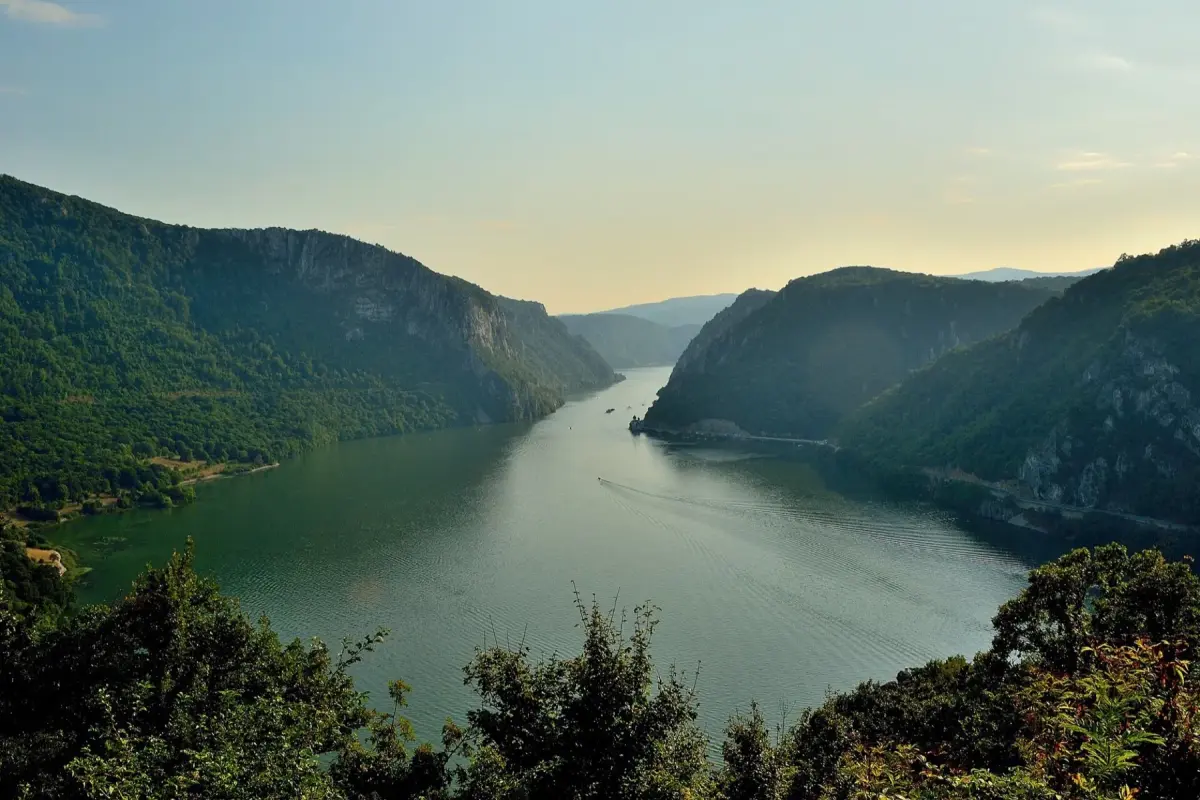
The area contains coniferous forests, rivers, caves, mineral springs, and waterfalls.
Natural sites often mentioned include Skakavac Waterfall, the Bele Vode springs, Hajdučka Cave and Red Cave, as well as the Beli Rzav, Crni Rzav, and Kamešina rivers.
However, these should not be treated as a simple list of easy roadside stops.
One site may require a difficult drive, another a hike, and a third may become inaccessible after rain or during a particular season.
Before visiting any of them, check road conditions, trail access, and whether a local guide is needed.
In one day, it is better to see less than to spend the entire visit racing between places.
Mistakes That Make Mokra Gora Disappointing
The most common mistake is arriving without checking the timetable.
Drvengrad can be visited at almost any time.
The Šargan Eight runs at fixed hours, and the train determines the entire structure of the day.
The second mistake is expecting uninterrupted open views from the railway.
There are many tunnels, and part of the route passes through forest. The scenery does not appear every minute. The finest panoramas usually open at the stops, while the real pleasure lies in the journey itself: the sound of the carriages, the darkness of the tunnels, and the gradual climb through the mountains.
The third mistake is assuming that the heritage train will necessarily be pulled by a real steam locomotive.
The steam engine remains the symbol of the line, but a particular departure may use another locomotive.
Do not tie the entire experience to a single image from tourist advertising.
The fourth mistake is expecting Drvengrad to be a real historic town.
It is a twenty-first-century artistic settlement. Some of its old log houses were transported from nearby villages, but the complex itself was created by Kusturica and makes no secret of its cinematic origins.
The fifth mistake is giving Drvengrad an entire day.
The town is small.
Unless you are staying overnight, attending a festival, planning a long meal, or have a particular interest in Kusturica’s films, it makes more sense to combine it with the railway.
The sixth mistake is allowing only two or three hours for Mokra Gora.
Within that time, you can either rush through Drvengrad or see the station.
A full train journey barely fits into such a schedule.
Finally, do not spend the entire trip sitting in one place inside the carriage.
Some of the strongest moments happen away from the window.
Step out at the stops. Look at the loops of the railway, the forest, and the valley.
When access to the open platform between carriages is permitted, spend part of the journey there while following all safety rules.
Who Will Truly Enjoy Mokra Gora
Mokra Gora is particularly rewarding for people who believe the journey can matter as much as the destination.
Railway enthusiasts will find more than a decorative attraction. This is a restored section of a technically complex mountain line.
Fans of Kusturica can step into a space that continues his films not on a screen, but in the physical world.
Families with children often remember the tunnels, the old carriages, and the unusual character of the journey.
Those tired of fast transfers and compulsory sightseeing lists may appreciate the slow rhythm of the train and a day built around one short railway line.
The place can appeal even to someone who knows little about Serbian cinema and has no particular interest in railway engineering.
It is enough to enjoy strange stories—especially those in which things turn out not to be what they first appear.
But Mokra Gora is not for everyone.
Two hours of rattling and hard wooden seats may be tiring for anyone who dislikes old trains.
The carriages can become hot in summer.
Part of the route is hidden by forest and tunnels.
Drvengrad may feel too small and staged to someone searching for a genuine, non-touristy village.
Expectations matter.
Mokra Gora does not promise a monumental landscape around every bend, nor does it pretend to be a forgotten medieval town.
Its value lies elsewhere—in the unusual meeting of railway, cinema, and mountain country.
What to Combine with Mokra Gora
The simplest plan is a day trip from Zlatibor, combining the two main experiences: the Šargan Eight and Drvengrad.
A two-day journey offers more possibilities.
Spend the first day in Mokra Gora, stay overnight, and continue the next morning to Tara National Park, Zaovine Lake, or the house on the Drina near Bajina Bašta.
Another option is to continue towards Višegrad.
There you will find the bridge over the Drina associated with Ivo Andrić’s novel, as well as another Kusturica project: Andrićgrad, sometimes referred to as the Stone Town.
After visiting the wooden village on a Serbian hillside, it is especially interesting to see the director’s stone-built town on the other side of the border.
Trying to combine everything in one day is not advisable.
Mokra Gora loses much of its meaning when reduced to a brief stop between several distant destinations.
Where Reality and Fiction Changed Places
In 2021, Mokra Gora was among forty-four villages recognised by the United Nations World Tourism Organization as Best Tourism Villages.
This does not mean it was declared the single best village in the world.
But the recognition helps explain why people continue to come here, even though neither of its two main attractions is quite what it first appears to be.
The Šargan Eight is a real historic railway.
It was once needed to carry people from one city to another.
Today, it does not take passengers anywhere in the conventional sense. The train returns them to the same station from which they departed.
A genuine transport route has become a journey undertaken for the journey itself.
Drvengrad, by contrast, began as fiction.
It grew from a film, from the tastes of one director, from old log houses moved to a new hill, and from streets named after people Kusturica chose to gather inside his imagined town.
Yet this invented village now exists in an entirely real way.
Guests sleep here. Restaurants operate. Films are shown. Cultural events are held. Every morning, doors open and life begins again.
One part of Mokra Gora was once real and now performs its past for travellers.
The other was invented for cinema and gradually became a real place.
Between the two move visitors who board an old carriage in the morning, climb the hill to the wooden town in the afternoon, and by evening can no longer say exactly where history ended and scenery began.
Perhaps that is why Drvengrad was never dismantled after filming.
Some films end with the credits.
Others leave behind a handful of recognisable images.
Here, cinema built a village, brought new attention to a forgotten railway, and remained among the Serbian mountains—so convincingly that it now feels as though it has always belonged to the landscape.