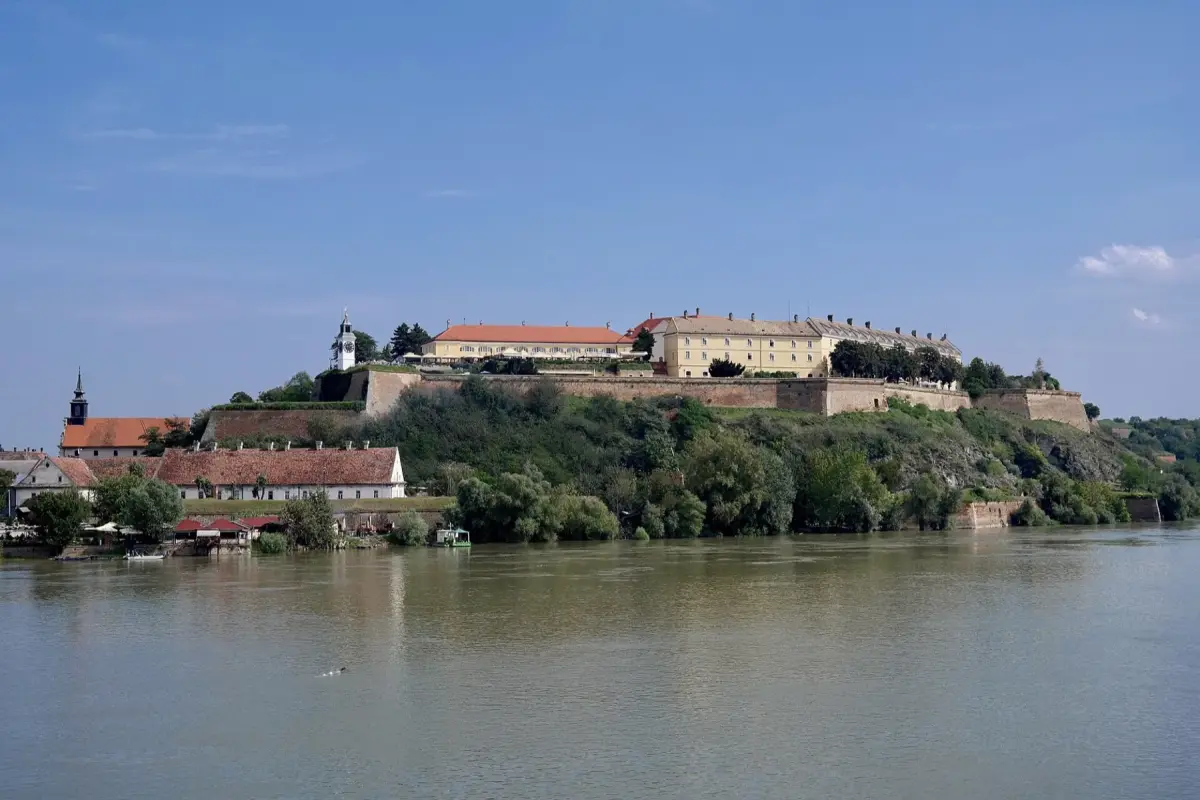
Sixteen kilometres of underground military galleries hide beneath one of Europe's great fortresses.
Most people visit Petrovaradin Fortress for its sweeping views of the Danube and its famous clock tower. Few realize that the most remarkable part of the fortress lies beneath their feet. Hidden underground is a place that many visitors find even more fascinating than the fortress itself.
Beneath the stone walls stretches nearly 16 kilometres of underground military galleries. Four levels of corridors, hundreds of chambers, stairways, loopholes, ventilation shafts, and wells form a true underground city. Invisible from the surface, this hidden network was one of the main reasons Petrovaradin became known as one of Europe’s most formidable fortresses.
Another Fortress Beneath the Fortress
When most people hear the word tunnels, they imagine a handful of damp passageways.
Petrovaradin’s underground galleries are something entirely different.
This vast military complex stretches for about 16 kilometres across four underground levels. If all the corridors were laid out in a straight line, they would almost reach from the centre of Novi Sad to Sremski Karlovci.
The underground even has its own climate. The temperature remains close to 12°C (54°F) throughout the year—refreshingly cool in summer and surprisingly mild in winter.
What makes it even more extraordinary is that many visitors walk across the fortress without ever realising this labyrinth exists beneath them. From above, Petrovaradin already looks enormous. Underground, it becomes something much larger.
Why Build a Fortress Underground?
By the 18th century, fortresses were threatened by more than cannons.
Military engineers had learned to dig tunnels beneath defensive walls, pack them with gunpowder, and bring entire bastions down with a single explosion.
After witnessing the destructive power of this tactic in earlier European wars, Austrian engineers decided that Petrovaradin needed protection not only above ground, but below it as well.
That decision led to the construction of an immense counter-mine system.
Its purpose was never to hide soldiers. Instead, it was designed to prevent enemy miners from reaching the fortress walls unnoticed.
In other words, Petrovaradin defended itself not only with massive ramparts, but with an entire hidden world beneath them.
“In other words, Petrovaradin defended itself not only with massive ramparts, but with an entire hidden world beneath them.”
The War No One Could See
While artillery fired above ground, another battle unfolded below.
Soldiers stationed in the galleries listened for the sound of enemy picks striking the earth. If they detected an approaching tunnel, they dug their own passage to intercept it.
Explosives were then placed underground and detonated before the attackers could reach the fortress.
It was a battle fought almost entirely out of sight. Two armies might never meet on the surface, yet clash deep beneath the ground.
That invisible war was exactly what this labyrinth was built for.
A Masterpiece of Military Engineering
The galleries were never a collection of random tunnels. They were part of a carefully planned engineering project.
Each of the four levels had its own purpose. The upper passages connected different parts of the fortress, while the deepest galleries were closest to where enemy tunnels were expected.
The complex required tens of millions of bricks to build. Thousands of ventilation shafts kept fresh air circulating, making the galleries surprisingly comfortable even today.
To prevent soldiers from getting lost, engineers created their own navigation system, marking each level and corridor throughout the maze.
Standing underground, it’s easy to forget that this entire system was designed and built more than two centuries ago.
What You Can Visit Today
The entire underground city is not open to the public.
Visitors can explore roughly one kilometre of the galleries on guided tours organised by the Museum of Novi Sad.
Even this small section is enough to appreciate the scale of the fortress. The tour takes you through long brick corridors, past firing loopholes, military chambers, and parts of the original counter-mine system.
Since the temperature remains around 12°C (54°F) year-round, it’s worth bringing a light jacket even in the middle of summer. Comfortable closed shoes are also recommended, as the route includes old staircases and uneven brick floors.
The City Most Visitors Never Discover
Most people leave Novi Sad with photographs of the Danube and Petrovaradin’s famous clock tower.
But it is underground that the fortress truly reveals why it was once considered one of Europe’s strongest military strongholds.
There are no panoramic viewpoints here. No cafés. No street musicians. Only cool air, endless brick corridors, and a silence that makes it easy to imagine the invisible war once fought beneath the fortress.
That is why Petrovaradin’s underground galleries are far more than another tourist attraction. They reveal the hidden half of the fortress—the part that remained out of sight for centuries.