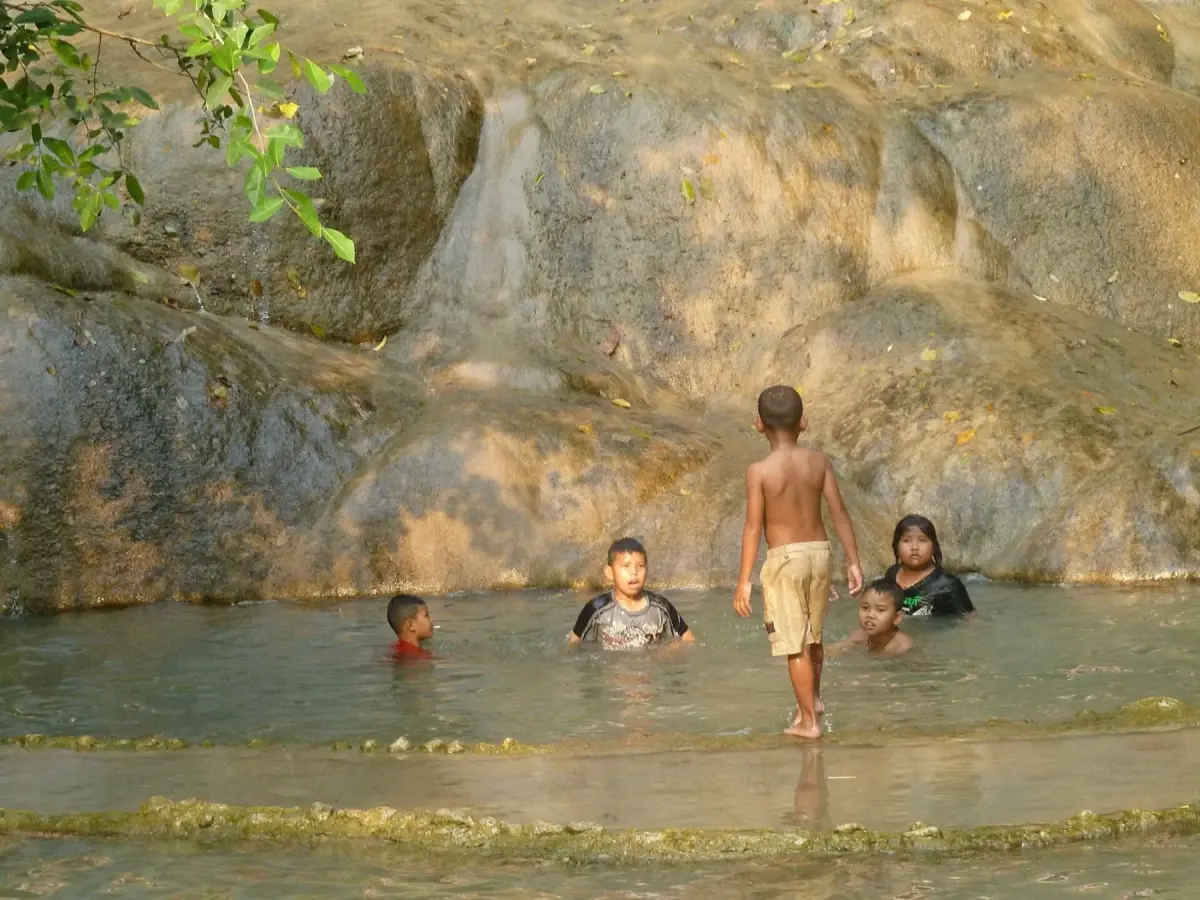
A limestone cascade you climb through step by step, rather than simply admire from below.
Sai Yok doesn’t end where the water begins to fall.
In many ways, that is where it truly begins.
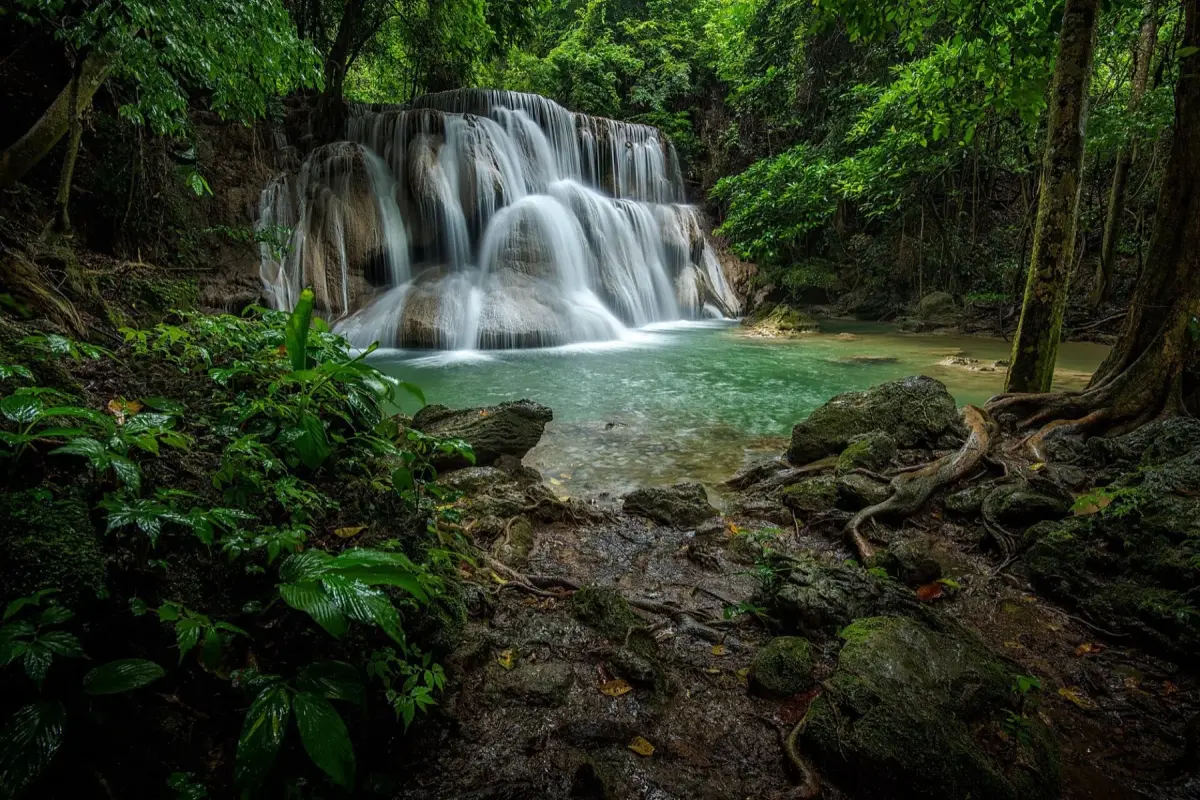
White streams descend across a broad limestone cliff, splitting apart, merging again, and disappearing between uneven stone steps. Instead of one continuous curtain of water, you discover an entire landscape that invites exploration. You climb a little higher, cross to the next cascade, pause beside a quiet natural pool, and then notice another stream that was almost invisible from below.
That is why people come to Sai Yok Noi not simply to admire a waterfall.
They come to move with the water, discovering it one step at a time.
Why You Actually Want to Walk Through This Waterfall
Sai Yok Noi, also known as Khao Phang Waterfall, is about fifteen metres high. Yet what defines it is not its height, but the broad limestone face over which the water descends in a series of cascades.
In one section, the water drops almost vertically. Elsewhere, it glides in a thin sheet across pale stone before gathering in small natural pools below.
Because of this, there is no single viewpoint from which you can honestly say you’ve seen the entire waterfall.
Visitors move between accessible sections, climb alongside the cascades, and stop wherever the water reveals a different shape. Whether you can walk across the wet limestone depends on the water level, recent weather, and any temporary safety restrictions, so it is always important to follow barriers and instructions from park staff.
A Trail Millions of Years in the Making
This remarkable landscape exists because of limestone.
Over countless ages, flowing water gradually shaped the rock, revealing its natural contours and creating the ledges that now divide the waterfall into multiple streams.
Nature built something resembling a giant stone staircase.
It was never intended for people.
Yet its very shape makes this unusual walk beside the water possible.
Without limestone, Sai Yok would feel completely different.
The water might plunge in a single uninterrupted drop, leaving visitors to admire it from a distance.
Instead, the geology itself encourages you to move, explore, and experience the waterfall piece by piece.
Every Cascade Reveals a Different Waterfall
Sai Yok cannot be understood in a single glance.
From below, you see only the beginning.
The upper sections reveal themselves gradually as you climb.
Within just a few metres, the sound of the water changes. In one place it roars loudly, while in another it softens into a gentle flow across smooth stone. The changing current transforms the light, the shape of the cascades, and even the feeling of the surrounding space.
Rather than existing as one dramatic scene, the waterfall unfolds as a sequence of smaller moments.
“Rather than existing as one dramatic scene, the waterfall unfolds as a sequence of smaller moments.”
To truly experience it, you have to keep walking, stopping, and looking again.
History Flows Beside the Water
Just beside the waterfall runs one of Thailand’s most significant historic railway lines.
Built during the Second World War, it became known as the Death Railway because of the forced labour of Allied prisoners of war and Asian workers, many of whom lost their lives during its construction.
Today, passenger and sightseeing trains still travel this route.
The journey passes through Kanchanaburi and the valley of the Khwae Noi River, making the railway itself part of the experience.
An old steam locomotive stands beside Sai Yok Noi as a reminder of that past.
The contrast is striking.
People now come here to listen to flowing water and spend a peaceful afternoon, yet only a few steps away remains the memory of one of the region’s darkest chapters.
One Waterfall, Two Completely Different Personalities
Sai Yok Noi changes dramatically with the seasons.
One visitor may arrive to find a broad white cascade covering much of the limestone cliff.
Another, returning just a few months later, may discover only thin ribbons of water tracing the same rock.
The waterfall is usually at its fullest between July and October.
During these months, the forest becomes intensely green, the cascades are at their most dramatic, and you can hear the water long before reaching the cliff.
But greater beauty comes with greater caution.
After heavy rain, the limestone becomes extremely slippery, the current strengthens, and some sections may temporarily close for safety reasons.
From November to January, temperatures are generally more comfortable, and there may still be plenty of water after a good rainy season.
Between February and May, the waterfall is more likely to appear subdued, while March and April also bring intense heat.
For that reason, it is worth checking recent weather conditions rather than relying only on the calendar.
Recent visitor photographs and park announcements often provide a much better idea of what the waterfall actually looks like before your trip.
A Few Things Worth Knowing Before You Go
When searching on maps, make sure you’re looking for Sai Yok Noi Waterfall, Namtok Sai Yok Noi, or its Thai name, น้ำตกไทรโยคน้อย. Don’t confuse it with Sai Yok Yai, another waterfall located deeper inside Sai Yok National Park, where the water drops directly into the Khwae Noi River.
By car, the journey from Bangkok usually takes about four hours each way. A day trip is possible, but spending eight or more hours on the road for a relatively compact waterfall can be tiring. A much more relaxed option is to spend one or two nights in Kanchanaburi or somewhere along the Khwae Noi River.
If you don’t have a car, the train is an excellent alternative. Daily trains leave Thon Buri Station in Bangkok for Nam Tok Station, from where the waterfall is about 1.4 kilometres away. You can easily walk the remaining distance or take a local ride.
On weekends and public holidays, sightseeing trains may continue directly to Nam Tok Sai Yok Noi Station, located beside the waterfall itself. Schedules and fares should always be checked for your travel date through the official SRT D-Ticket service, at railway ticket offices, or via the State Railway of Thailand’s information line (1690).
The train is considerably slower than driving, but in this case, the journey is part of the experience. The route follows the historic Death Railway through Kanchanaburi and alongside the Khwae Noi valley, making the trip itself one of the highlights.
Most visitors spend one to two hours exploring the waterfall. If you want enough time to wander across the accessible sections, sit beside the water, and enjoy the surroundings without rushing, it is worth leaving yourself a little extra time.
It is also wise to check current opening hours and entrance fees shortly before your visit. Different sources sometimes provide conflicting information, and the admission fee for the main area of Sai Yok National Park should not automatically be assumed to apply to Sai Yok Noi. There may also be separate parking charges or local fees.
Wear shoes with good grip, bring a change of clothes, insect repellent, and waterproof protection for your phone. Flip-flops may be comfortable near the lower viewing area, but they are poorly suited to wet limestone, which can become extremely slippery even when the water appears calm.
Weekends can be busy. Parking, food stalls, and other visitor facilities are located nearby, so Sai Yok Noi does not feel like a remote jungle waterfall.
The visit combines well with the historic railway at Tham Krasae, the Hellfire Pass Memorial, the main area of Sai Yok National Park, or an overnight stay in a floating river house on the Khwae Noi. Trying to fit all of these into a single day from Bangkok, however, usually turns the trip into a race from one stop to the next.
Who Will Enjoy It?
Sai Yok Noi is perfect for travellers who enjoy exploring nature slowly and noticing how a place changes every few steps. You don’t need advanced hiking skills, a long climb, or a demanding trek to appreciate it.
The waterfall is especially rewarding for anyone interested in unusual geology, historic railways, or places where nature and history come together. It works particularly well as one stop during a relaxed weekend in Kanchanaburi.
Those expecting one of the world’s great waterfalls may be disappointed. Sai Yok Noi is relatively compact, sits close to the road, and during the dry season can look much smaller than photographs taken after heavy rain suggest.
It is also not the right destination if your goal is complete solitude or a long wilderness hike. Visitors with poor balance, joint problems, or unsuitable footwear should avoid walking on the wet limestone, even if others appear to be doing so comfortably.
Don’t Confuse the Names
It is surprisingly easy to mix up the similar names in this area.
Sai Yok Noi Waterfall, Namtok Sai Yok Noi, and Khao Phang Waterfall all refer to the same waterfall featured in this article.
Nam Tok Sai Yok Noi is the railway stop beside the waterfall, where sightseeing trains may arrive on weekends and public holidays.
Nam Tok is the terminus for the daily trains from Bangkok. It is located about 1.4 kilometres from the waterfall.
Sai Yok Yai is a completely different waterfall in another part of the national park. Make sure you choose the correct destination when planning your trip.
Sometimes a Waterfall Is Better Walked Than Watched
By now, it becomes clear why Sai Yok doesn’t end where the water begins to fall.
That is where your journey through its limestone terraces, quiet pools, and ever-changing streams truly begins.
There is no single perfect viewpoint here.
The waterfall continues through every new cascade, every shift in the sound of the water, and every slow step across the pale stone.
Perhaps that is why, after the trip, you remember neither the height of Sai Yok nor one perfect photograph.
What stays with you is the walk itself—the few quiet hours during which the waterfall gradually stopped being a landscape to admire and became a place you were able to move through.